
Toward a sustainable global medical dialogue: The vision behind the International Open Medical Journal
DOI:
https://doi.org/10.65364/iomj.2025.01Keywords:
International Medical Congress, Global medical dialogue, Systems medicine, Translational medicineAbstract
In the long evolution of modern medicine, what truly drives the accumulation of knowledge and the improvement of practice is not a series of isolated, point-by-point technological breakthroughs, but a “dialogue mechanism” that operates continuously between historical inheritance and future frontiers; this mechanism has gradually assumed a multi-dimensional structure that propels medical practice forward. Tracing back to the cross-disciplinary exchange and publication coordination established by the International Medical Association (IMA) in the nineteenth century, medical knowledge has advanced through mutual verification and stepwise progression across multiple scales—from microbes and cells to tissues and organs, and from individuals to populations. Today, disciplinary fragmentation, evidentiary fragmentation, and rapid technological turnover coexist, bringing unprecedented opportunities while posing new demands for integration and governance. Situated precisely at this juncture, the founding of the International Open Medical Journal (IOMJ) is grounded in history, framed by an integrative system view of medicine, and guided by clinical and public interests; it encourages bidirectional convergence between basic and clinical research, embraces multi-omics and AI-based analysis with prudence, and advances a sustainable global medical dialogue within an ethical and societal framework.
In the long evolution of modern medicine, medical progress is driven not by isolated technological breakthroughs, but by a continuous ‘dialogue mechanism’ linking historical foundations with future developments; this mechanism has gradually assumed a multi-dimensional structure that propels medical practice forward. Tracing back to the cross-disciplinary exchange and publication coordination established by the International Medical Congress (IMC) in the 19th century, medical knowledge has advanced through mutual verification and stepwise progression across multiple scales, from microbes and cells to tissues and organs, and from individuals to populations. Today, disciplinary fragmentation, evidentiary fragmentation, and rapid technological turnover coexist, bringing unprecedented opportunities while posing new demands for integration and governance. Situated precisely at this juncture, the founding of the International Open Medical Journal (IOMJ) is grounded in history, framed by an integrative system view of medicine, and guided by clinical and public interests; it encourages bidirectional convergence between basic and clinical research, embraces multi-omics and AI-based analysis with prudence, and advances a sustainable global medical dialogue within an ethical and societal framework.
HISTORY AND RATIONALE FOR LAUNCH
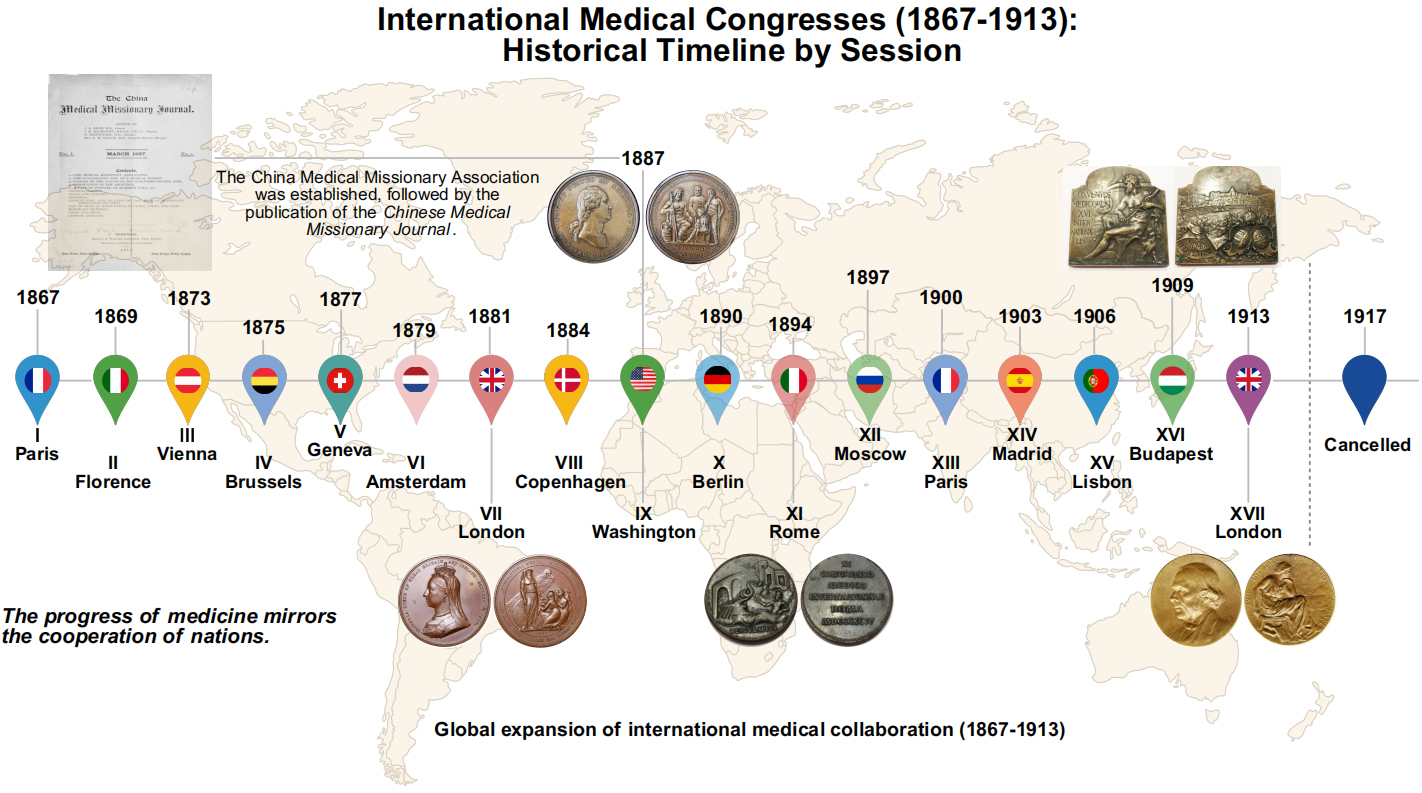
Since the 19th century, the tradition of international medical congresses - initiated by the proposal of Professor Henri Giutrac of France in 1865 and first realized at the 1867 Paris International Exhibition - has played an important role in shaping how medical knowledge is exchanged and recorded[1]. To commemorate Giutrac’s foundational proposal for the IMC, the International Medical Association (IMA) was established to carry forward this spirit[2]. While the 1867 congress did not formally establish a fixed "congress → journal → durable knowledge" paradigm, its proceedings and subsequent reporting practices contributed to a pattern in which congress activities increasingly interacted with scholarly publication and long-term knowledge accumulation. This emerging linkage helped lay the groundwork for later efforts to sustain international medical dialogue and cooperative scholarship. Early commentaries (1881) supplied the conceptual footing for institutional scholarly interplay[3]; Copenhagen (1884), propelled by Peter Ludvig Panum and colleagues, further institutionalized agendas and publication practices[4,5]. Berlin (1890) and reports from leading journals documented the continuity of this enterprise[6,7]. Moscow (1897) refined congress organization and proceedings compilation[8,9]; a series of reports around Madrid (1903) mapped section structures and thematic focus[10-14]. Budapest (1909) consolidated these mature arrangements[15], and London (1913) marked a zenith in scale and scope, with commemorative medals and formalized collected volumes affirming its self-understanding as a global medical forum[16]. The First World War interrupted this sequence, yet the animating ethos of advancing public knowledge through sustained scholarly dialogue has endured [Figure 1].
Figure 1.Chronological atlas of International Medical Congresses, 1867-1913, illustrating the global diffusion of medicine through serial gatherings.
As shown in the historical timeline (1867-1913), the IMC helped cultivate early practices through which congress activities increasingly interacted with published proceedings and broader scholarly communication, linking scientific exchange with the gradual accumulation of durable knowledge. The World Health Organization (WHO, 1948) later institutionalized intergovernmental health governance, while the World Medical Association (WMA, 1947) codified medical ethics and professional conduct. Collectively, the historical IMC tradition highlights early forms of knowledge collaboration, while WHO later came to embody intergovernmental policy coordination and WMA took on the role of ethical stewardship. The rationale for launching the International Open Medical Journal (IOMJ) is precisely to rebuild, amid contemporary disciplinary fragmentation, evidentiary atomization, and global health inequities, a central node for an integrative perspective and ongoing dialogue, so that discoveries from disparate levels and regions can be recognized, connected, and carried forward.
FROM MICRO TO MACRO: THE MEDICAL LANDSCAPE
Modern medicine advances not through isolated inflection points alone, but by widening those breakthroughs into system-level progress, an iterative exchange across scales of knowledge. Signals at the microbial and cellular levels must be interpreted alongside tissue- and organ-level phenotypes to understand health outcomes in individuals and populations. IOMJ advocates an "inside-out, micro-to-macro" analytic pathway: we encourage studies to situate themselves and related work within a single coherent picture, to specify links to upstream and downstream evidence, to acknowledge uncertainty and boundaries, and to leave room for cross-disciplinary interfaces. Our priority is whether the question is consequential and whether the evidence can speak across adjacent scales, rather than the virtuosity of any single technique; what matters is that evidence at different scales mutually explain and jointly strengthen one another.
FOUNDATIONS AND TRANSLATION: CONSOLIDATING DISCOVERY INTO AN INHERITABLE KNOWLEDGE ASSET
Insights from basic science are the fundamental driver of medical progress; truly forward-looking translation goes beyond one-off validation and aims to sediment discovery into cumulative, inheritable knowledge assets. IOMJ will prioritize work that establishes a traceable chain of evidence: clearly delineating the provenance of the problem, positioning the study in relation to prior evidence, demonstrating mutual corroboration from early-stage research to broader application settings, and, on that basis, formulating actionable next scientific questions. We encourage authors to explain how hypotheses evolve and research plans are updated, so that findings become persuasive now, usable in the future, and foundational for clinical and public health decision-making.
CLINICAL INTEGRATION: PATIENT-CENTERED EVIDENCE INTEGRATION
In real-world settings, clinical problems routinely transcend specialty boundaries; multimorbidity, cross-organ syndromes, and the interplay between perioperative care and chronic disease management make continuity from disease to pathway, and from pathway to outcomes particularly critical. Guided by the patient journey, IOMJ will bring together researchers across disciplines to address the same clinical question and build evidence that is complementary and mutually reinforcing. We encourage authors to show how evidence reaches the bedside and how it is perceived by patients, and to foreground equity and access, enabling cross-learning across diverse resource settings and populations. Crucially, rapid cycles of technological innovation and artificial intelligence do not justify technocentrism; rather, they call for coupling implementation with prudent checks and continuous post-deployment monitoring within clear governance frameworks.
TECHNOLOGY HORIZON: OPPORTUNITIES AND BOUNDARIES OF MULTI-OMICS AND INTELLIGENT ANALYTICS
Advances in cross-disciplinary measurement and computation, exemplified by multi-omics (genomics, epigenomics, transcriptomics, proteomics, metabolomics, microbiome) and AI-based analytics, continue to widen the representational space of disease, while simultaneously magnifying tensions at the interfaces of data-model-context. IOMJ adopts a stance of measured optimism: we encourage studies that draw evidence from multiple fields and generate new hypotheses, and we welcome clear and honest statements about uncertainty and limitations. However cutting-edge the tools, their scholarly and societal value ultimately depends on clinical relevance, interpretability and adoptability across resource settings, and a legitimate balance with the public interest. Accordingly, we advocate adherence to the FAIR data principles to enhance the findability and reusability of discoveries[17]; and we look to the core tenets of the World Health Organization’s guidance, including Ethics and Governance of Artificial Intelligence for Health (2021), Regulatory Considerations on AI for Health[18] (2023), and Guidance on the Ethics and Governance of Multimodal Large Models (LMMs)[19] (2024), as forward-looking reference points. Within this framing, the historical congress → journal → durable knowledge loop gains contemporary support: not merely announcing breakthroughs, but connecting, accumulating, and responsibly governing knowledge.
KNOWLEDGE ECOLOGY AND ANALYTICAL INTEGRATION IN CONTEMPORARY MEDICINE
In the contemporary context, medicine no longer evolves within disciplinary enclaves but within a knowledge ecology characterized by data density, institutional pluralism, and global interdependence. The analytical paradigms of the twentieth century, including statistical inference, randomized control, and linear translation, are increasingly challenged by nonlinear, multi-source evidentiary systems that require both cognitive inclusiveness and architectural coordination. Artificial intelligence, multi-omics, and systems medicine do more than provide tools; they reshape how medical knowledge is produced, validated, and applied. Yet this transformation also exposes critical tensions: between prediction and explanation, between algorithmic scalability and clinical contextuality, and between private innovation and public accountability.
The future of medicine faces challenges that extend beyond technological breakthroughs, encompassing resource allocation, system governance, global collaboration, and equity. For instance, Katz highlights the severe inadequacy of funding-tracking mechanisms in pandemic preparedness, which undermines the overall resilience of medical systems[20]. Blendon emphasizes that structural inequities and social determinants within the U.S. healthcare system will become central issues for the future of medicine[21]. More pointedly, Salminen warns that the WHO, as the principal global public health coordinating body, is currently experiencing a "dual crisis of resources and credibility"[22]. Against this backdrop, the historical IMC tradition can inform how neutral, knowledge-oriented platforms might complement broader global health efforts, particularly in facilitating knowledge exchange and collaboration in resource-limited regions.
For IOMJ, addressing these tensions requires advancing a form of scholarship that is reflexive, integrative, and ethically grounded - where computational insights are interrogated through biological plausibility, reproducibility is treated as both a social and technical norm, and the circulation of data and knowledge adheres to the dual imperatives of openness and responsibility. In this sense, the "global medical dialogue" that IOMJ seeks to reconstruct is not only a continuation of history but also a modern infrastructure for epistemic integration, aligning discovery with governance and innovation with equity.
CONCLUSION: SUSTAINING THE DIALOGUE, LOOKING AHEAD
From the IMC tradition to today’s journal community, what most merits stewardship is long-horizon patience with important problems and mutual respect across diverse forms of evidence. IOMJ seeks to institutionalize that discipline by linking micro to macro, bench to bedside, methods to ethics, and innovation to the public interest, so that the dialogue mechanism that once sustained durable knowledge continues to function within contemporary technological and social contexts. We invite authors, reviewers, and readers to place their work within this broader framework, aiming not for short-term novelty but for a medical future that is credible, inheritable, and actionable.
References
- Therapeutic Memoranda. Br Med J. 1884;2:561.DOI
- The International Medical Association. The Lancet.. 1880; 116:153. DOI
- The International Medical Congress. J Ment Sci.. 2018; 27:403-5. DOI
- The International Medical Congress at Copenhagen. The Lancet.. 1884; 124:382-4. DOI
- Peter Ludvig Panum (1820-1885) Danish epidemiologist and physiologist. JAMA.. 1967; 201:196-7. DOI
- International Medical Congress, Berlin, 1890. JAMA.. 1890; XIV:214-6. DOI
- Medical News. Edinb Med J. 1893;2:189.DOI
- Blomfield A. The International Congress of Medicine, Moscow, 1897: a good arrangement. The Lancet.. 1897; 149:1116. DOI
- Roth WK, Editor
- Medical Notes in Parliament. BMJ.. 1901; 2:366. DOI
- The Fourteenth International Congress of Medicine, Madrid. The Lancet.. 1903; 161:923-4. DOI
- Woodley Stocker W, Davies C. The Fourteenth International Congress of Medicine, Madrid. The Lancet.. 1903; 161:838. DOI
- THE Fourteenth International Congress of Medicine, Madrid, April, 1903. The Lancet.. 1902; 160:1642. DOI
- The Fourteenth International Congress of Medicine, Madrid, 1903. The Lancet.. 1903; 162:249-50. DOI
- The Sixteenth International Congress of Medicine. Budapest, August 29th to September 4th: section of medicine. BMJ.. 1909; 2:1076-7. DOI
- Saleeby CW. The International Medical Congress. Nature.. 1913; 91:608-10. DOI
- Wilkinson MD, Dumontier M, Aalbersberg IJ. The FAIR Guiding Principles for scientific data management and stewardship. Sci Data.. 2016; 3:160018. DOI
- Katz R. Challenges of tracking funding for pandemic preparedness and response. Lancet Glob Health.. 2023; 11:e310-1. DOI | PubMed
- Blendon RJ, Blumenthal D, Glied S. Critical health care challenges for the next U.S. president. N Engl J Med.. 2024; 391:e36. DOI | PubMed
- Salminen MO, Helve O, Ullum H. The urgent need to protect WHO is also an opportunity. Lancet.. 2025; 405:693. DOI | PubMed |
Downloads
Additional Files
Published
Data Availability Statement
Not available
Issue
Section
License
Copyright (c) 2025 Shaodi Wen, Zhengbo Song,Xinjian Li, Xingxiang Pu (Author)

This work is licensed under a Creative Commons Attribution-NonCommercial 4.0 International License.